Orpheus and Eurydice: Myth, Grief, and the Soul’s Journey
Preface: Why This Myth Still Matters
Some stories survive not because they are entertaining but because they are true, not factually, but psychologically. They name something about the human condition so precisely that no subsequent culture, however different, has been able to set them aside. The myth of Orpheus and Eurydice is one such story.
It has attracted the work of moral philosophers, poets, playwrights, painters, composers, choreographers, sculptors, novelists, and filmmakers for over two and a half millennia. As noted by Jungian analyst Dawson (2000), presenting a modern psychological perspective, the myth has elicited interpretations “from practically every tradition of human thought that has encountered it” (p. 4). Virgil told it. Ovid told it. Monteverdi made it the subject of the first opera. Rainer Maria Rilke wrote his Sonnets to Orpheus in a single burst of inspiration (Rilke, 1922/2005). Cocteau put it on film. The reason for the myth's persistence is not nostalgia. It is recognition.
At the center of the myth is one of literature’s most psychologically precise moments: a man descends to the underworld to rescue his beloved, but as he returns to the light, he looks back at her and loses her forever.
Why? That is the question this article sets out to answer through the story itself and three great interpretive traditions that have sought to make sense of it: existential psychology, Jungian depth psychology, and the ancient spiritual tradition of Orphism from which the myth emerged. The story that follows is not only a myth of the ancient world, but it is also a complete psychological, philosophical, and spiritual map. Each element of its account corresponds with striking precision to the deepest questions of what it means to love, to lose, to grieve, and to find oneself again.
Part One: The Story
A Birth Between Heaven and Earth
Orpheus was born in Thrace, the wild mountainous region of northern Greece, to parents who placed him from the first between the human and the divine. His mother was Calliope, the greatest of the nine Muses and the patron of epic poetry. His father, according to varying traditions, was either the river-god Oeagrus or Apollo, the god of music, light, and the sun (Grimal, 1987). Apollo is said to have given him his golden lyre personally (Pindar, 5th century BCE/1997).
His talent was unlike anything the world had known. When Orpheus played and sang, nature itself stopped to listen. Animals ceased their predatory natures and gathered peacefully around him. Rivers halted their courses. Rocks and trees uprooted themselves and moved closer (Ovid, 8 CE/2000). He was more than a musician—he embodied the ancient Greek conviction that beauty and art possess a power transcending reason, force, and nature itself.
The Argonauts: A Hero of a Different Kind
Before the story of Eurydice, Orpheus earned his fame alongside the greatest heroes of his age. He sailed with Jason and the Argonauts on their quest for the Golden Fleece. Not as a warrior, but as the expedition’s singer and spiritual anchor (Apollonius of Rhodes, 3rd century BCE/2009). The wise centaur Chiron had prophesied to Jason that the mission would fail without him (Apollonius of Rhodes, 3rd century BCE/2009). His weapon was not a sword but his lyre.
His most celebrated contribution came when the Argo neared the island of the Sirens, the half-woman, half-bird creatures whose singing was so devastatingly beautiful that every sailor who heard it steered toward the rocks and was destroyed. As the crew started to fall under their spell, Orpheus took out his lyre and played a song more beautiful than theirs, drowning out their fatal call with something that pointed toward life rather than death (Apollonius of Rhodes, 3rd century BCE/2009). The Argonauts sailed past safely.
He also used his music to lull the great serpent guarding the Golden Fleece in the sacred grove to sleep, allowing Jason to seize it. Throughout the voyage, Orpheus calmed storms, settled quarrels amongst the crew, and appeased hostile gods. He returned from the quest a man of proven heroism but of a wholly different kind.
Eurydice and the Wedding That Was Already a Funeral
After his return, Orpheus fell deeply in love with Eurydice, a beautiful nymph of Thrace (Ovid, 8 CE/2000). Their union seemed destined, and the wedding ceremony was already shadowed by a dark omen. When Hymen, the god of marriage, appeared to bless the union, his ceremonial torch refused to light properly. It only smoked and sputtered, filling the eyes of the guests with tears rather than brightening the celebration (Ovid, 8 CE/2000, Metamorphoses, Book X).
What came next… While Eurydice walked through the meadows with her companions, dancing in some versions of the myth, fleeing the unwanted advances of the shepherd Aristaeus in others, she stepped on a serpent hidden in the grass (Virgil, 29 BCE/1999, Georgics, Book IV). The snake struck her heel. She died instantly (Ovid, 8 CE/2000).
Orpheus was inconsolable. His grief poured into music so devastating that all of nature mourned with him. Trees bowed. Rivers wept. Both humans and gods came to know his sorrow (Ovid, 8 CE/2000).
The Descent into the Underworld
No mortal had ever voluntarily descended into the kingdom of the dead. Orpheus did.
With nothing but his lyre, he passed through the entrance at Taenarum (a cave on the southernmost tip of the Peloponnese said to open directly into Hades) and walked into the world of the dead (Virgil, 29 BCE/1999). He charmed the threshold-guardians into stillness. Cerberus, the three-headed dog, lay down. Charon, the ferryman who normally demanded the coin of the dead, rowed him across the Styx River (Ovid, 8 CE/2000).
At the court of Hades and Persephone, Orpheus made his petition through music and words that were themselves music. In Ovid’s (8 CE/2000) rendering:
I have not come here to see dark Tartarus, nor to bind Cerberus. I come for my wife. A viper she trod on diffused its venom into her body and robbed her of her best years. I longed to accept it, and I do not say I have not tried: Love won. He is a God well known in the world above. I beg you: reverse Eurydice’s fate, too soon spun out. (Metamorphoses, Book X, as translated by Kline, 2000)
The effect was extraordinary. The shades of the dead stood still and wept. Tantalus forgot his unquenchable thirst. Ixion’s eternally spinning wheel stopped turning. The Furies, the pitiless goddesses of vengeance who had never wept, wept (Ovid, 8 CE/2000).
Persephone interceded with her husband, and the condition was granted: Eurydice would follow Orpheus back toward the world of the living, but he must not look back at her until both of them had fully passed into the upper world (Virgil, 29 BCE/1999; Ovid, 8 CE/2000).
The Ascent and the Fatal Glance
The two began the long climb through the dark passages of the underworld. Orpheus walked ahead. Eurydice followed behind him, still slow and limping from the wound in her heel (Ovid, 8 CE/2000). The path was steep and dark.
Orpheus could not hear Eurydice’s footsteps. He could not see her. He could not know whether she was truly there. Whether Hades had honored his promise, whether she was real or merely another shade made to deceive him. And then, just as they neared the threshold “not far from the edge of the upper world” (Ovid, 8 CE/2000, Metamorphoses, Book X), his nerve broke.
Virgil (29 BCE/1999) captures the moment in language that still arrests the breath: cum subita incautum dementia cepit amantem: “a sudden madness seized the incautious lover” (Georgics, Book IV). He turned and looked.
Eurydice was already dissolving back into the dark. She spoke to him, gently, without reproach: “What madness has destroyed my wretched self, and you? See, the cruel Fates recall me, and sleep hides my swimming eyes. Farewell!” (Virgil, 29 BCE/1999, Georgics, Book IV). And with a last vale, farewell, she sank back down, and was gone (Ovid, 8 CE/2000; Virgil, 29 BCE/1999).
He reached for her. His hands closed on nothing but air (Ovid, 8 CE/2000).
Orpheus rushed back to the Styx River and begged Charon to carry him across again. But now the ferryman refused. For seven days, Orpheus sat on the bank, neither eating nor drinking, while the dark waters flowed past him (Ovid, 8 CE/2000).
The Years of Mourning
Orpheus returned to the world above alone. For three years, he drifted through the wilderness of Thrace, refusing all human company, pouring his anguish into music (Ovid, 8 CE/2000). He had turned away from the world that contained both the joy and the sorrow of Eurydice.
The Dismemberment and the Singing Head
The Maenads, the wild female devotees of the god Dionysus, attacked Orpheus during one of their ecstatic Bacchic rituals (Ovid, 8 CE/2000, Metamorphoses, Book XI). His unbroken mourning, his rejection of women, and his devotion to the rival god Apollo appeared to them as the ultimate insult to the life-force they served. At first, his music protected him. Rocks refused to strike him, branches veered away (Ovid, 8 CE/2000). But the women’s frenzy eventually exceeded even the power of his song. They fell on him with their bare hands and tore him limb from limb (Ovid, 8 CE/2000).
His severed head and his lyre were thrown into the river Hebrus (Ovid, 8 CE/2000). They floated downstream, and the head kept singing. Even in death, separated from its body, the head of Orpheus sang melodies of love and loss, and the lyre played beside it as they floated toward the sea (Ovid, 8 CE/2000). Both eventually washed ashore on the island of Lesbos, which thereafter became famous as the birthplace of lyric poetry (Ovid, 8 CE/2000). The Muses buried his body at the foot of Mount Olympus, where the nightingales are said to sing more sweetly than anywhere else on earth (Ovid, 8 CE/2000).
The Reunion
The myth does not end in tragedy, or rather, it gives the tragedy a final, quiet turn.
The soul of Orpheus descended once more into the underworld. And there, in the Elysian Fields, the world of the blessed dead, he was reunited with Eurydice (Ovid, 8 CE/2000). In Ovid's account, he now looks back at her freely. She turns and meets his eyes. They wander there together still, side by side at last, with no condition between them, no prohibition against looking.
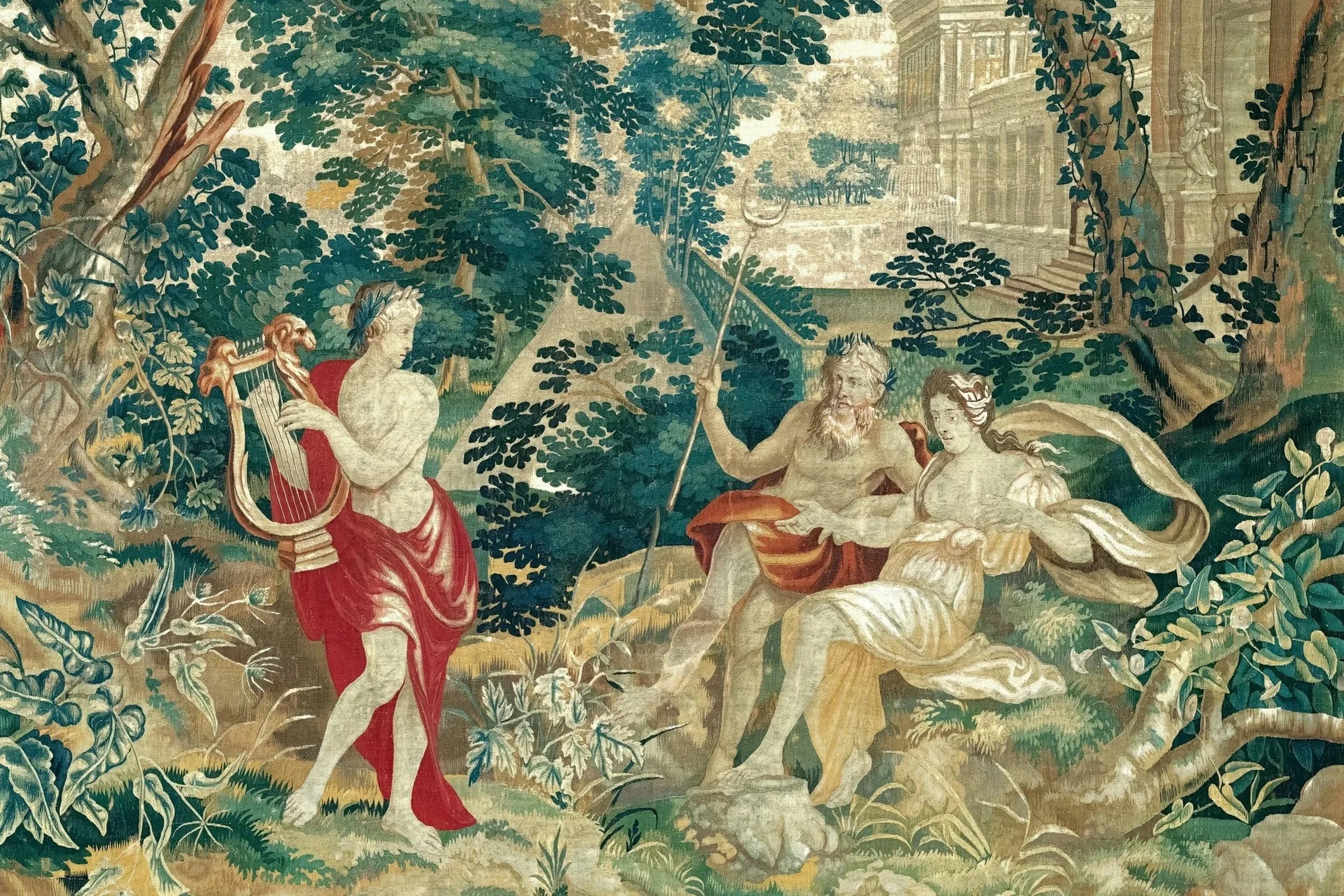
Photo by Art Institute of Chicago @artchicago via Unsplash.
Part Two: What the Myth Tells Us
The Myth in Its Full Arc
The myth of Orpheus and Eurydice is a psychological, philosophical, and spiritual map. Each element of the story corresponds with striking precision to questions that lie at the heart of existential psychology, Jungian analytical psychology, and the ancient spiritual tradition of Orphism. What follows is an integrated reading of all three.
Existential Psychology: Death, Anxiety, and the Unlived Life
The Four Ultimate Concerns
Irvin Yalom (1980), an American psychiatrist and leading existential psychotherapist, argued in Existential Psychotherapy that four ‘ultimate concerns’ structure all deep human anxiety: death, freedom, isolation, and meaninglessness (p. 8). The myth of Orpheus dramatizes all four, but its primary territory is the first. It is, above all, a myth about mortality and our compulsive strategies for refusing it.
Orpheus mourns with a fury that alters the natural world. Birds and rivers and stones weep with him. Yet he cannot accept his wife’s death. After pouring his loss into three years of wandering and song, he descends into Hades not to escape feeling but to undo the irreversible.
This is a critical distinction, and it is precisely the one Yalom (2008) illuminates in Staring at the Sun: Overcoming the Terror of Death. There, drawing on decades of clinical work, Yalom observed that death anxiety is “a symptom not so much of fear of death as fear of an unlived life” and, conversely, “the more unlived your life, the greater your death anxiety” (Yalom, 2008, p. 142).
With Eurydice, Orpheus had felt most fully alive; without her, his life collapses, and death becomes something to negotiate with and outwit rather than to accept. Orpheus cannot live forward because he cannot accept that she is irretrievably gone.
The parallel becomes concrete in Yalom’s own account of losing his wife of more than sixty‑five years, the historian and author Marilyn Yalom. She was not only his spouse but his intellectual companion and frequent co‑author, sharing his home, work, and daily practice of thinking and writing.
In A Matter of Death and Life (I. D. Yalom & M. Yalom, 2021), the two co-wrote alternating accounts of her dying of cancer and his grieving. After her death, Yalom wrote of the enormity of his loss: “I lost so much of my life when I lost her” (I. D. Yalom & M. Yalom, 2021, p. 178). He finds himself rereading his earlier books on grief and discovering that the guidance he once offered patients must now be applied, imperfectly and painfully, to himself.
Rather than set Yalom apart as a singular “real‑world Orpheus,” his testimony underscores that Orpheus’s dilemma is widely human: anyone who has organized their sense of aliveness around a dear other face, in bereavement. The figure of Orpheus, in this light, gives mythic form to an experience that countless mourners, including Yalom, recognize from the inside.
The myth also illuminates what Yalom (1980) called the “emergence-embeddedness dialectic”: the tension between the wish to merge with another (embeddedness) and the need to individuate into one’s own separate existence (emergence) (p. 362).
Orpheus’s tragedy is that he has merged so completely with Eurydice that he no longer experiences a coherent sense of self apart from her. His passage into the underworld is not, at depth, about rescuing Eurydice; it is about recovering the part of himself he has projected into her. The backward glance reveals this: he cannot walk forward into the light while she remains unseen and unconfirmed behind him.
Rollo May: Love, Will, and the Daimonic
Rollo May (1969), an American existential psychologist (1909–1994) who helped introduce existential philosophy into psychotherapy, argues in Love and Will that genuine love requires an integration of eros, the expansive, desirous dimension of love, with will, the capacity to choose and to commit (p. 73). When eros overwhelms will, love becomes captivity rather than liberation. Orpheus embodies eros at its most absolute, but at the threshold between darkness and light, his will collapses, and he cannot sustain the tension between love and the irreversibility of loss.
May (1969) wrote extensively about the daimonic, any natural human force that can “take over” the whole person and has the power both to create and to destroy (for example, passion, rage, or creative inspiration) (p. 123). The daimonic is the wellspring of Orpheus’s music: the same depth-force that lets him charm Hades is, when unintegrated, what compels the backward glance and clouds his judgment. The backward glance is the daimonic asserting itself over the conscious will.
In the introduction to Love and Will, May (1969) notes that in times of deep rupture, people often “cling to each other and try to persuade themselves that what they feel is love” (p. 14). This describes Orpheus at the cusp of the upper world: he clings to Eurydice and to the fantasy of reversing death, rather than exercising will to accept her loss and live forward.
Viktor Frankl: Suffering and the Search for Meaning
Viktor Frankl (1946/2006), an Austrian neurologist, psychiatrist, Holocaust survivor, and founder of logotherapy, argued in Man’s Search for Meaning that suffering is not the enemy of meaning; it is one of meaning’s primary conditions: “if there is a meaning in life at all, then there must be a meaning in suffering. Suffering is an ineradicable part of life, even as fate and death. Without suffering and death, human life cannot be complete” (p. 67).
From this perspective, Orpheus’s descent was not wrong; it was a heroic act of love. His error was that he could not derive meaning in the irreversibility of Eurydice’s death. Frankl (1946/2006) observed that “the prisoner who had lost faith in the future, his future, was doomed" (p. 82). After the second loss, Orpheus becomes exactly that prisoner: alive in body, wandering, producing music, but no longer oriented towards any future.
The myth enacts, with mythic precision, the clinical distinction between mourning and melancholia that Freud (1917/1957) first mapped in Mourning and Melancholia. Mourning is the painful but forward-moving process of integrating loss into a life that can still mean something; melancholia is the endless recursive dwelling on the lost object that forecloses the future altogether (Freud, 1917/1957, pp. 243–258). Orpheus, after the second loss, is in melancholia and remains there until the Maenads and the river Hebrus complete, by force, the transformation he could not choose.
Jungian Depth Psychology: The Underworld as the Unconscious
The Descent as Individuation
For Jung (1966), the descent into the underworld wasn't merely a mythological motif but a precise metaphor for the psychological journey that he called individuation: the lifelong process of integrating unconscious contents into conscious awareness to approach the wholeness of the Self (p. 173). Jung (2009) described his own period of inner crisis (1913–1917) as a deliberate descent, a descent into the unconscious recorded in what would become the Red Book. He recognized in it the same pattern as the mythic journeys of Orpheus, Odysseus, and Dante.
In this framework, Orpheus’s entire story is a drama of an attempted individuation that is instructively failed. The underworld is the collective unconscious; Eurydice is the anima, Jung’s term for the contra sexual soul-image, described as “the archetype of life itself” (Jung, 1954/1966, para. 66, as cited in Dawson, 2000, p. 6); the condition of not looking back is the requirement that the ego surrender its controlling gaze to allow the soul to follow freely into consciousness. The backward glance is the moment when the ego fails this requirement, choosing to possess rather than to trust (Dawson, 2000; Zhangalova, 2021).
The Figures as Archetypes
Each figure in the myth maps onto a dimension of the psyche with striking completeness:
Orpheus: The conscious ego: rational, creative, gifted, but controlling (Zhangalova, 2021)
Eurydice: The anima: the soul-figure, the archetype of life itself (Dawson, 2000, p. 6)
Hades / Persephone: The Self in its deepest aspect: the ruling principle of the unconscious (Jung, 1966)
The condition of not looking back: The ego's required surrender of control; trust in the individuation process (Dawson, 2000)
The backward glance: Ego inflation and the compulsive need to possess what can only be encountered in darkness (Dawson, 2000, p. 11)
The Maenads / Dismemberment: The destruction of the inflated ego; initiation that arrives by force when not chosen freely (Ovid, 8 CE/2000)
The singing head on the river: The indestructible creative spirit that survives ego-dissolution (Rilke, 1922/2005)
The key insight is that the anima can be encountered when the ego relinquishes its demand to see, control, and verify. As Terence Dawson (2000), a Jungian analyst and scholar of analytical psychology, observed, the “fatal glance” is the compulsive act of a man who “cannot trust the process of individuation: he must see and possess what can only be encountered in darkness, in process, in the gradual ascent through the unconscious” (p. 11).
There is also a significant cognitive-psychological dimension to the myth’s structure. The command “do not look back” encodes its own violation. Every time Orpheus repeats the prohibition to himself, he is forced to think the very thought he is trying to suppress. This anticipates what social psychologist Daniel Wegner (1994) identified as ironic process theory: the well-documented finding that attempts to suppress a thought reliably produce its recurrence under conditions of cognitive strain. The long, dark, silent passage through the underworld creates exactly the conditions of cognitive vulnerability described in research on rumination. Orpheus could not charm himself.
The Orpheus Complex
Dawson (2000), in his landmark paper in the Journal of Analytical Psychology, identified the Orpheus Complex, a specific psychological pattern defined by:
A shattering loss of meaning following the departure or death of a specific person who carried intense soul-projection
A yearning to recover the person who is mistaken for love, but reflects the need to recover a dissociated part of the self
Psychological inflation: a grandiose identification with the role of tragic hero-artist, which produces creative output but prevents genuine relational contact
Escalating retreat into an imaginal, self-referential world
Inability to mourn and move forward (Dawson, 2000, pp. 12–15)
The critical insight is that the loss of the anima-carrier is experienced as the loss of one's own capacity to feel alive. This is why Orpheus cannot simply mourn and continue. He is not mourning her; he is mourning himself (Dawson, 2000, p. 16).
The Eurydice Complex: The Other Side of the Myth
The so-called “Eurydice Complex,” as used in this article, is an interpretive framework drawing on myth and feminist analysis rather than a formal psychoanalytic diagnosis.
Terence Dawson (2000) identified a corresponding pattern he calls the Eurydice Complex: the wound experienced by a woman who has been profoundly abandoned or betrayed by a partner or inner animus figure she has heavily idealized and relied on as her “Orpheus,” someone appearing as protector or guide and claiming to offer safety or rescue (pp. 18–20).
In real life, this “Orpheus” may be a romantic partner, a father who fails to protect his daughter, or a therapist, coach, or spiritual teacher who appears as a protector or guide but ultimately misuses or neglects the power entrusted to them. Like the wizard in The Wizard of Oz, such a figure can seem impressive and assuring on the surface yet remains unable or unwilling to offer the genuine protection and guidance he promises.
Research suggests it is not only love but also blind idealization that hands such figures their power. For many women, though this pattern may be relevant to other groups as well, especially when early caregivers could not be safely idealized, a later partner or healer may become the first person placed on that inner pedestal, making the eventual betrayal feel like a collapse of the world itself (see Dawson, 2000). Taken together, these dynamics amount to a moral injury: the violation of fundamental expectations of care and integrity by someone idealized as a protector, which fractures trust not only in that person but also in one’s own judgment and in the reliability of the human world.
The complex is defined by:
A depression that feels like being permanently trapped in the underworld
A searing wound of abandonment and the collapse of trust
The long, slow, difficult re-emergence into one’s own selfhood
The eventual fierce reclamation of autonomy and inner life (Dawson, 2000, pp. 18–20)
The Eurydice Complex raises, at its core, the question of whom we trust and on what basis. As the artist Eartha Kitt powerfully stated, “Trust is something to be earned.” Yet, as May (1969) shows in Love and Will (p. 73), falling in love and idealizing another often loosens our capacity to will and to judge, so that we give trust and power long before the other has truly proven themselves. In some cases, love and idealization may set the stage for later disappointment (May, 1969). Eurydice’s wound, and that of many women in real life, lies in the collision between these two truths: the necessity of trust for love and healing, and the grave outcomes once trust is given to someone who has neither earned it nor knows how to bear its ethical weight.
In this light, Eurydice’s silence has often been interpreted as representative of women’s erasure in myth and literature; she may also be seen as representing those whose trust in a promised guide has been shattered, and whose deepest work is the slow return from the underworld into a hard‑won, self‑authored life. Hilda Doolittle (1917/1983), an American poet writing under the name H.D., was among the first to give this experience literary form. In her poem "Eurydice," written from Eurydice’s perspective, she captures not longing for Orpheus but the discovery of inner resources: “I have the flowers of myself, / and my thoughts, no god / can take that” (Doolittle, 1917/1983, p. 52, as cited in Dawson, 2000, p. 19). The myth itself does not close with Eurydice as victim. In Ovid’s (8 CE/2000) version, it ends with her free, finally able to turn and meet Orpheus’s eyes on equal terms, without condition.
Dawson (2000) developed the Eurydice Complex as a pattern he observes primarily in women, though its underlying structure, profound idealization of a guiding figure, followed by betrayal or rupture and a kind of psychic underworld exile, may not be exclusive to women, and could apply to people of other genders in different contexts.
Jung’s Descent and What Orpheus Could Not Do
Jung himself underwent what he later described as a descensus ad infernos—a descent into the underworld of his own unconscious—after the break with Sigmund Freud, whom he had intensely admired and in many ways idealized as a father and guide (Jung, 1961/1989). In this sense, Jung’s rupture with Freud has an Eurydice dimension: a trusted “Orpheus” figure collapses, and the ensuing descent into the unconscious forces a re‑founding of self that no longer depends on an external savior.
Jung (2009) entered a period of near‑psychosis in which he deliberately allowed himself to sink into the depths of his inner world, recording his experiences in what would become the Red Book. Later Jungian authors have read this as a modern, Orphic‑type descent: unlike Orpheus, who clings to his guiding figure and tries to control the underworld through his music, Jung let the idealization collapse and submitted to the darkness itself. He stopped looking for an outer Orpheus and turned instead toward the inner figures and images that arose from the unconscious. He did not grasp or demand control; he allowed the unconscious to speak, sat with the terror, and returned transformed. His entire analytical psychology is, in one sense, a manual for the voyage that Orpheus could not complete, a way of moving from inflation and idealization toward individuation, where guidance comes not from an external savior but from the Self.
Orphism and Ancient Spirituality: The Myth as Initiation
The Mystery Religion
The myth of Orpheus not only generated interpretations but also a religion. Classical scholar Walter Burkert (1985) notes that Orphism, one of the most influential mystery cults of the ancient world, was built on the symbolic life and teachings attributed to Orpheus. By the fifth century BCE, an established Orphic movement had formed with traveling priests, sacred texts, rituals, and a body of doctrine that differed profoundly from mainstream Greek religion (Graf & Johnston, 2013).
The core Orphic beliefs were:
The human soul (psyche) is immortal and subject to metempsychosis (reincarnation), cycling through successive lives until sufficiently purified to escape the cycle (Graf & Johnston, 2013)
Human beings carry an original wound: humanity was created from the ashes of the Titans, who had consumed the divine child Dionysus-Zagreus, meaning that every human soul contains both a divine spark (from Dionysus within the Titans) and an impure residue (from the Titans themselves; Graf & Johnston, 2013)
The goal of Orphic practice was liberation from what the texts call the “circle of grief,” the perpetual cycle of death and rebirth, and ultimate reunion with the divine source (Graf & Johnston, 2013)
Music, poetry, contemplation, and ritual purity were the primary spiritual disciplines (Burkert, 1985)
For Orphic followers, Orpheus’s descent into Hades was not simply a failed love story but may be interpreted as a demonstration that death could be transcended, and that knowledge of the underworld’s structure, acquired while still living, could guide the soul to liberation (Graf & Johnston, 2013). Orpheus’s descent functioned as the founding act of initiation, the model that every Orphic initiate was understood to undergo in symbolic form through the mysteries (Burkert, 1985).
The Orphic Gold Tablets
The most astonishing physical remnants of the Orphic tradition are the Orphic Gold Tablets. Classical philologists Fritz Graf and Sarah Iles Johnston (2013) note that these thirty‑five small pieces of gold foil, inscribed with ancient Greek text and found in graves across Greece and southern Italy from the fourth century BCE through the Roman Imperial era, were buried with initiates as guides for the soul’s journey through the underworld.
The longer tablets contain detailed navigational instructions: which fountain to avoid (the Lake of Oblivion, whose waters draw the soul back into forgetfulness and reincarnation) and which to seek (the Spring of Memory, beside a white cypress tree, whose waters allow the soul to remember its divine origin and claim its freedom; Graf & Johnston, 2013). At the guardian of the spring, the soul is instructed to declare: “I am a child of Earth and starry Heaven; but my race is of Heaven alone” (Orphic Gold Tablet, 4th century BCE, as translated in Graf & Johnston, 2013, p. 6).
This declaration is extraordinary in its psychological implications. The soul, standing before the guardians of death, must remember who it is, not its name, its deeds, or its social position, but it’s essential nature: both earthly and divine, capable of dissolution and of transcendence. The Gold Tablets reveal a sophisticated cosmology in which the underworld is not punishment but a liminal space that can be navigated with the right knowledge, the right memory, and the right words (Graf & Johnston, 2013).
The Shamanic Dimension
Scholars of comparative religion have frequently interpreted Orpheus as a shamanic figure because of his capacity to enter altered states, travel in between worlds, communicate with the dead and the divine, and use music as the primary “technology” of this crossing (Burkert, 1985; Graf & Johnston, 2013; Eliade, 1964). Mircea Eliade (1964), in Shamanism: Archaic Techniques of Ecstasy, notes structural similarities between the journeys of shamans in Siberian, Central Asian, and other indigenous traditions and mythical descents like that of Orpheus: a passage into the underworld in search of a lost soul, movement through dangerous liminal zones, and a return carrying knowledge that heals (pp. 407–410).
The detail of the singing head floating down the Hebrus belongs to this same shamanic logic. In Eliade’s (1964) terms, the shaman’s power does not reside in the ordinary body but in the song and in the capacity to cross worlds, and that power cannot simply be killed (pp. 3–4). Psychologically, the Maenads destroy not Orpheus’s deepest essence but the ego‑bound, grief‑imprisoned version of him. What the river carries to the sea is something older and more durable: the pure creative spirit, the voice of the soul itself, still oriented toward beauty, still singing the name of what it loved (Rilke, 1922/2005).
Plato’s Orphic Inheritance
Classical scholars such as Walter Burkert (1985) argue that Plato’s philosophy is saturated with Orphic influence to a degree often underplayed in introductory accounts: doctrines central to Plato, the immortality and pre‑existence of the soul, its need for purification, and its ultimate reunion with the divine, all bear the imprint of Orphic cosmology (Burkert, 1985; Plato, 4th century BCE/1997). In the Symposium, Plato (4th century BCE/1997) has Phaedrus sharply criticize Orpheus as “only a harp‑player” who “did not dare like Alcestis to die for love” but tried to sneak into Hades alive (p. 462).
Read against the Orphic background, this is not a casual insult but a theological judgment: Plato, drawing on Orphic ideas throughout his work, holds the cultural Orpheus to the very standard Orphism itself sets, that the true initiate meets death not with magical evasions and desperate clinging, but with the clear‑sighted calm of a soul that knows its own nature (Burkert, 1985).
The Three Dimensions in Dialogue
Read together, these three frameworks, existential, Jungian, and spiritual, reveal that the myth of Orpheus is not about three different things. It is about one thing, seen from three different angles: the human difficulty of trusting what cannot be controlled, seen, or verified.
Existential Psychology
Core Question: Can we live authentically in the face of irreversible loss?
Orpheus’s Failure: Cannot accept mortality; love becomes death-denying clinging (Yalom, 1980; Frankl, 1946/2006)
What Transformation Requires: Genuine mourning; forward-facing meaning; the courage to live without proof
Jungian Depth Psychology
Core Question: Can the ego surrender control and trust the individuation process?
Orpheus’s Failure: Cannot trust the unconscious; must possess what can only be encountered in darkness (Dawson, 2000; Jung, 1966)
What Transformation Requires: Ego-surrender; allowing the anima to follow freely; engaging the Self
Orphic Spirituality
Core Question: Can the soul remember its divine nature and escape the circle of grief?
Orpheus’s Failure: Returns without the transformative knowledge the descent could have yielded (Burkert, 1985; Graf & Johnston, 2013)
What Transformation Requires: The descent completed in full: descent, encounter, and return bearing transformation, not possession, but liberation
The backward glance is commonly interpreted as the same failure in all three registers. Existentially, it may represent the refusal to believe that life can continue to mean something without the beloved. From a Jungian perspective, it can be seen as the refusal to trust that the unconscious will bring what is needed without the ego’s control.
Spiritually, it is sometimes read as the failure to remember one’s own indestructible divine nature, an inability to know, in the deepest silence of that long dark ascent, that what one is searching for is already, and always has been, present.
Conclusion: What Survives the Dismemberment
The dismemberment that follows Orpheus’s second loss is not simply punishment. In Jungian terms, it is the initiation that arrives by force when it could not be chosen freely, the destruction of the inflated ego that had to happen before the deeper transformation could occur (Dawson, 2000, p. 22). The Maenads who tear him to pieces are not villains; they are instruments of the very Dionysian life-force that Orpheus, in his grief-bound devotion to Apollo's ordered light, had refused.
What the river carries to the sea is what survives all ego-dissolution: the creative, indestructible soul-voice, still oriented toward beauty, still singing the name of what it loved (Ovid, 8 CE/2000). The lyre plays beside it. They float together toward Lesbos, toward the birthplace of lyric poetry, toward the place where the wound of love becomes art (Boethius, 524/1999).
And in Elysium, quietly, the reunion occurs. Not achieved by force or desperate love or the charm of music, but by the simple, irrevocable completion of the journey through death that both Orpheus and Eurydice had to make, and finally made, alone (Ovid, 8 CE/2000).
He turns. She meets his eyes. There is no condition, no darkness, no rule against looking. There is only the recognition that was always there, waiting on the other side of trust.
© 2026 Dr. Kerstin Hecker. All rights reserved. No part of this article may be reproduced, distributed, or used in any form without prior written permission from the author, except for brief quotations with proper citation.
References
Apollonius of Rhodes. (2009). Jason and the golden fleece (The Argonautica) (R. Hunter, Trans.). Oxford University Press. (Original work written 3rd century BCE)
Boethius, A. M. S. (1999). The consolation of philosophy (V. E. Watts, Trans.). Penguin Classics. (Original work written c. 524 CE)
Burkert, W. (1985). Greek religion: Archaic and classical (J. Raffan, Trans.). Harvard University Press.
Dawson, T. (2000). The Orpheus complex. Journal of Analytical Psychology, 45(2), 245–266. https://doi.org/10.1111/1465-5922.00154
Doolittle, H. (H.D.). (1983). Collected poems, 1912–1944 (L. L. Martz, Ed.). New Directions. (Original work published 1917)
Eliade, M. (1964). Shamanism: Archaic techniques of ecstasy (W. R. Trask, Trans.). Princeton University Press.
Frankl, V. E. (2006). Man's search for meaning. Beacon Press. (Original work published 1946)
Freud, S. (1957). Mourning and melancholia. In J. Strachey (Ed. & Trans.), The standard edition of the complete psychological works of Sigmund Freud (Vol. 14, pp. 237–258). Hogarth Press. (Original work published 1917)
Graf, F., & Johnston, S. I. (2013). Ritual texts for the afterlife: Orpheus and the Bacchic gold tablets (2nd ed.). Routledge.
Grimal, P. (1987). The dictionary of classical mythology (A. R. Maxwell-Hyslop, Trans.). Blackwell. (Original work published 1951)
Jung, C. G. (1966). The practice of psychotherapy: Essays on the psychology of the transference and other subjects (R. F. C. Hull, Trans.; 2nd ed., Vol. 16, Collected Works of C. G. Jung). Princeton University Press. (Original work published 1954)
Jung, C. G. (2009). The red book: Liber novus (S. Shamdasani, Ed.; M. Kyburz, J. Peck, & S. Shamdasani, Trans.). W. W. Norton.
May, R. (1969). Love and will. W. W. Norton.
Ovid. (2000). Metamorphoses (A. S. Kline, Trans.). University of Virginia E-Text Center. http://ovid.lib.virginia.edu/trans/Metamorph10.htm (Original work published c. 8 CE)
Pindar. (1997). Odes (W. H. Race, Trans.). Harvard University Press. (Original works written 5th century BCE)
Plato. (1997). Complete works (J. M. Cooper, Ed.; various Trans.). Hackett. (Original works written 4th century BCE)
Rilke, R. M. (2005). In praise of mortality: Selections from Rainer Maria Rilke's Duino Elegies and Sonnets to Orpheus (A. Barrows & J. Macy, Trans.). Riverhead Books. (Original work published 1922)
Virgil. (1999). Georgics (P. Fallon, Trans.). Oxford University Press. (Original work published 29 BCE)
Wegner, D. M. (1994). Ironic processes of mental control. Psychological Review, 101(1), 34–52. https://doi.org/10.1037/0033-295X.101.1.34
Yalom, I. D. (1980). Existential psychotherapy. Basic Books.
Yalom, I. D. (2008). Staring at the sun: Overcoming the terror of death. Jossey‑Bass.
Yalom, I. D., & Yalom, M. (2021). A matter of death and life. Redwood Press.
Zhangalova, D. (2021). “I praise:” A Jungian interpretation of the myth of Orpheus [Unpublished master's thesis]. American University in the Emirates.